The Anatomy of a Perfect Customer
Every company has one customer who renews early, refers friends, and never haggles. Your ICP is the science of finding a hundred more of them. Here's how to actually do it.
Insights · · 3 min read

Close your eyes and picture your favorite customer.
Not the biggest logo. Not the one from the case study. The one who got it on the first call. Who onboarded themselves over a weekend. Who pays on time, renews early, and casually mentions you to three friends a quarter.
Every company has one. Most companies treat them as luck.
They're not luck. They're a pattern: and your Ideal Customer Profile is nothing more (and nothing less) than that pattern, written down precisely enough to hunt with. This article is about extracting it.
Why most ICPs describe nobody
The typical ICP is written like a horoscope: flattering, vague, and impossible to falsify:
"Mid-market B2B companies undergoing digital transformation, with forward-thinking leadership and a growth mindset."
Who isn't that? A definition that excludes nobody selects nobody. The result shows downstream:
- SDRs hunt on gut feel, so pipeline quality depends on who's hunting
- Marketing targets "everyone who could buy," so CAC creeps up
- Product hears feedback from customers who should never have been sold
- Churn analysis becomes archaeology: why did we even close this account?
An ICP is only useful when a stranger could look at a company and say yes or no using your criteria. Precision is the whole point.
Reverse-engineer, don't brainstorm
Great ICPs aren't invented in a workshop. They're excavated from your own history.
Pull your last 20–30 closed-won deals and score each one on three axes:
- Speed: how fast did it close relative to your average?
- Value: revenue, expansion, and how painless the negotiation was
- Health: are they active, renewed, referring?
The top quartile is your raw material. Now interrogate it:
- What industry and business model keeps showing up?
- What size band (employees and revenue) do they cluster in?
- Who was the champion? Title, seniority, team
- What was true the quarter they bought: hiring spree, new leader, funding, a tool they ripped out?
That last one is the secret. Firmographics tell you who could buy. Signals tell you who's ready. The perfect customer is almost always perfect timing wearing a company's clothes.
Write it like an engineer, not a poet
Once the pattern is visible, compress it into dials, not prose:
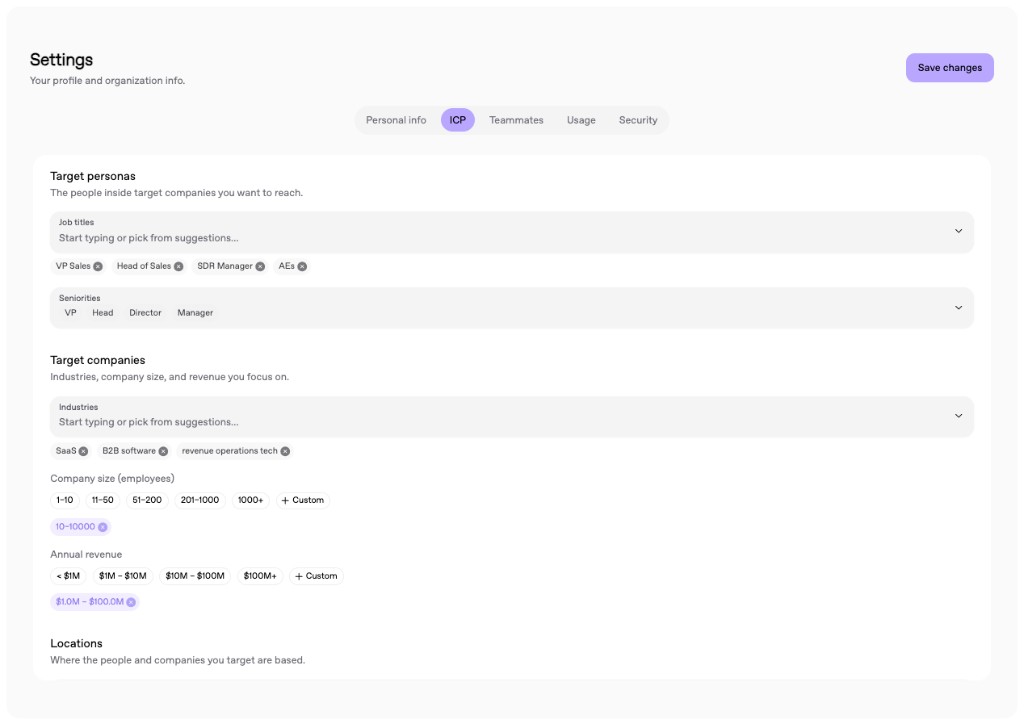
- Personas: VP Sales, Head of Sales, SDR Manager: the people who own the pain
- Seniority: Manager and above; below that you're pitching spectators
- Industry: SaaS, B2B software, revenue-operations tech
- Size: 10–10,000 employees; $1M–$100M revenue
- Geography: where you can legally sell and realistically support
- Timing signals: hiring SDRs, new sales leadership, recent raise
Notice what this looks like: configuration, not literature. Every line is checkable. Every line excludes someone. That's how you know it's working.
And once it's dials, it belongs in your tools: not in a slide. In Brainess, this exact structure lives in Settings → ICP, where Synapse uses it to score every company it hunts and to explain why each match made the list.
The compounding payoff
Here's what changes when the pattern runs the machine:
Week one: lead lists shrink and improve. You're no longer proud of volume; you're proud of fit.
Month one: outreach reply rates climb, because relevance is doing the work personalization templates never could.
Quarter one: win rates and sales cycles improve together: you're selling to people who were already on the journey.
Year one: churn drops, because the customers you closed were the ones you should have closed. Your best customer stops being an anecdote and becomes a category.
Revenue problems are usually selection problems wearing a disguise.
Fix who you talk to, and everything downstream gets easier.
Start this week
You don't need a committee. You need an afternoon:
- List your ten best customers by speed, value, and health
- Find the three traits and one timing signal they share
- Encode them as dials: personas, size, industry, geography, signals
- Point your prospecting at that definition and delete everything that doesn't match
- Revisit one dial every Monday; let evidence, not opinion, tune it
Then let the definition do the hunting. Get early access to Brainess and turn your best customer into a repeatable search query.